Last fall, I had the opportunity to see the new Kennedy Center original production of Little Dancer, inspired by Edgar Degas' statue: Little Dancer Aged 14. So naturally, I had to follow up with the production's sister exhibit!

A bit late (ok, a few months...), I headed over to the National Gallery of Art before the exhibit's closing weekend (sorry, it closed February 8th, but I was slow to post).

And, of course, I had to stop and take a picture of Mercury in the Rotunda. I love that the flower arrangements around him are always changing! These colorful blooms made it possible to hope that spring is actually around the corner.

After leaving the Rotunda, I made my way towards the impressionist galleries and the Degas exhibit.


And there she was. Little Dancer Aged 14. Although there are over thirty bronze and two plaster versions of her, this is original sculpture. The only one he touched and the only sculpture he exhibited during his life.
And she is beautiful!

After seeing the musical, where there is a scene about the dressing of the statue, it was very interesting to see what she is actually wearing: a cotton and silk tutu, linen ballet slippers, and a simple ribbon.

What I found most fascinating were all of the materials used to support the statue. Degas used many items within the structure of the statue, including broken paint brushes!

The exhibit also includes other works by Degas, including other sculpture studies.

 |
| Study in the Nude of Little Dancer Ages Fourteen (Nude Little Dancer), c. 2878-1881. |
And the paintings! Degas was famous for capturing life within the Paris Opera Ballet, the beautiful, the ordinary, and the ugly.
His studies the Ballet has always been some of my favorites. I have had a print of Degas' La classe de danse in my room for years. He is one of my favorite artists and I was so happy with the rest of this exhibit. It had a wonderful selection of his paintings and studies.
 |
| The Dance Class (Ecole de Danse), c. 1873 |
 |
| The Dance Lesson c. 1879 |
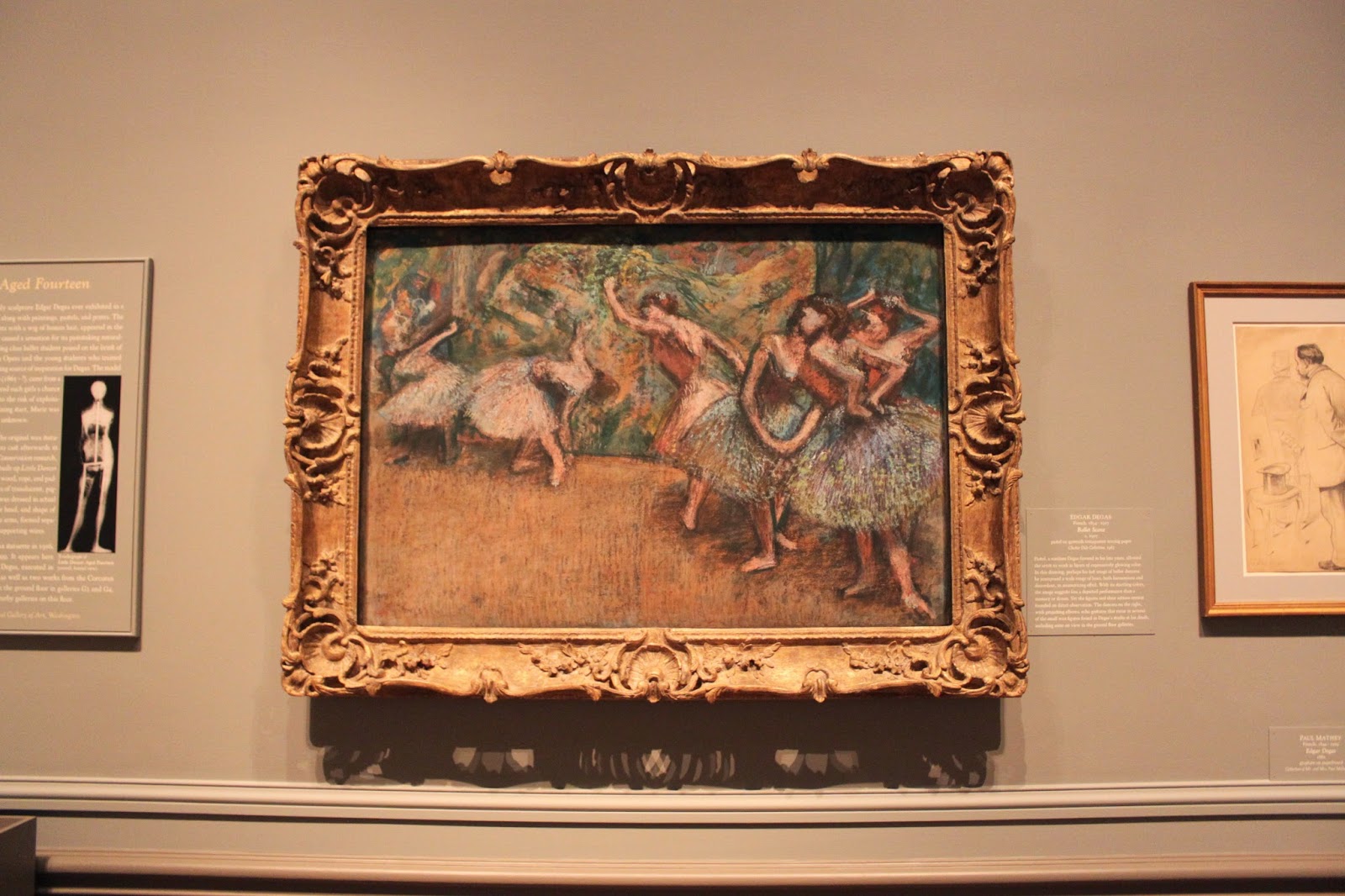 |
| Ballet Scene c. 1907 |
 |
| The Ballet Master (Le maitre de ballet), c.1874) I think this was my favorite one in the exhibit. I loved the emotion and the starkness of colors. It was just amazing. |

The exhibit was beautifully done. I wished that they had connected it more to the musical, as both the National Gallery and the Kennedy Center had advertised the exhibit as a companion exhibit for the original musical. But having seen the musical, the exhibit really helped explain Degas' history with the Paris Opera Ballet, which lasted over forty years.
And while you might have missed the exhibit (sorry again that I didn't get to it earlier in the run!), you can see Little Dancer Ages 14 in all her glory at the National Gallery, as she is a part of their regular collection.
The National Gallery of Art is free and open to the public Monday through Saturday from 10:00 a.m. to 5:00 p.m. and Sunday from 11:00 a.m. to 6:00 p.m.


