Showing posts with label Irish Diaspora. Show all posts

Wednesday, January 21, 2015

The Irish Hunger Memorial - Battery Park City

Hello everyone! I am sorry that I have been away so long, but between work and dissertation, that sometimes happens.

I promise that I have many museum adventures to share with you, but I thought that I would start out with a short post on a memorial close to my research heart: the Irish Hunger Memorial in New York City.


Located on the Battery Park City, only a few blocks away from the 9/11 Memorial, the Irish Hunger Memorial is a truly unique memorial. The memorial was built in 2002 and was designed to raise awareness about the events surrounding the Irish Famine.


I first heard about the memorial on a travel show about New York City a few years ago. The host was exploring some of the lesser known museums and memorials around NYC, including the Hunger Memorial. I remember being extremely interested in this memorial that juxtaposed the busy urban landscape of New York with the quite and empty landscape surrounding many of Ireland's clearance houses.

So, upon my most recent trip to New York, I made sure to make time for this museum between the city's bigger players, like the Met and the American Museum of Natural History. And it was worth it!


Walking to the memorial, the grassy knoll is the first thing that indicates that you have arrived. But to get onto the pathway, you must first go around the the memorial's entrance, which is a stark modern contrast to the memorial's grassy top.


All around the base are quotes and statistics about the Famine, reminding visitors of the shear numbers associated with the Famine.


As you make your way up to the grassy top, you walk through a traditional Irish cottage from the Famine era, brought over from County Mayo and painstakingly reconstructed for this memorial.


And as you walk along the meandering path, you notice that some of the stones have the names of the Irish counties carved into them. These stone were brought over from each of the 32 counties as a reminder the Famine's impact on Ireland.


It is a beautiful memorial, although vastly different from the majority of Famine memorials around the United States and Ireland. Most memorials focus on the imagery of the people, starving and weak, leaving their homeland in hopes of finding something better. But this memorial is different. It focuses on the impact the Famine had on the country. The loss of the people from both death and emigration had a long lasting effect on Ireland. And that loss is what seems to be echoed here in Battery Park City.

To learn more about the Irish Hunger Memorial, click here to visit the website.

Thursday, August 22, 2013

Fáilte to Pollak Vineyards!

So, one more summer post on my own work before getting back into new exhibits. Another fun event associated with my dissertation work is the Irish Festival that Clann Mhór hosts every year at Pollak Vineyards in Greenwood, Virginia. 

The front of the tasting room (Courtesy of a post to yelp.com)


The festival is a fun day of Irish music, wine tasting, history, and - of course - archaeology. Last year's field school took place on the Pollak Vineyard, so it has become a great place for this event to be held. 

UMD Field School 2012 - Pollak Vineyard

The back room of the Vineyard's tasting room facility is turned into a small exhibit, a combination of Clann Mhór's work on the historical research on both the railroad big wigs and the Irish laborers and the University of Maryland's archaeological work on the laborer's domestic sites (aka. my dissertation work). Here members of Clann Mhór and the students from the archaeological field school talk with community members and winery visitors about the history of the Irish in the area and the legacy they left behind (see Tunnel Post).


Apart from the exhibit, the event facilitates a lot of good conversation between land owners, local historians, archaeologists, and history aficionados. 


You never know what new piece of information you could pick up or what clue you could get into the complex Irish landscape. 

Dr. Stephen Brighton of the University of Maryland talking to land owner Kane Ivey.

And of course, a summer Sunday afternoon event at Pollak Vineyard wouldn't be complete without a wine tasting. I opted for the rosé this time, although their Meritage is my favorite from the Vineyard. 

Barry explaining the different wines to visitors.

Outside, musicians play throughout the day. The traditional Irish music entertains the crowd with lively reels and jigs from the band...


...as well as the hauntingly beautiful traditional ballads, which often describe losses associated with the Famine. 


 Even the field school students were able to get out and enjoy the music and the scenery before going back into to the exhibit room. 


This amazing event allows me to share my work with the local community each summer, helping to reestablish an Irish presence in one of the most celebrated historical landscapes in Virginia (Monticello is pretty much right down the road). And none of it would be possible without the amazing work of the members of Clann Mhór.

Marjorie, Rhonda, Dan, and me.

Now its time to pop back to the 1850s to make sure we're digging in the right places!


Thursday, August 8, 2013

The Tunnel- An Adventure Back in Time

This post is a little of the beaten path, literally. I decided to share one of my favorite experiences of the summer: the field trip to the Blue Ridge Railroad Tunnel. Over the summer, I am the graduate field director for an archaeology field school run through the University of Maryland. The archaeology field school focuses on sites associated with the Irish laborers who built the railroad tunnels through the Blue Ridge Mountains outside of Charlottesville, Virginia. And so once a summer, we go visit the longest and most impressive of those tunnels so that the students can get a better understanding of what the Irish laborers did. 

So let the adventure begin!


Its a bit of a hike to get to the tunnel, which is owned by Nelson County and is private property (aka don't go there unless you have their permission).


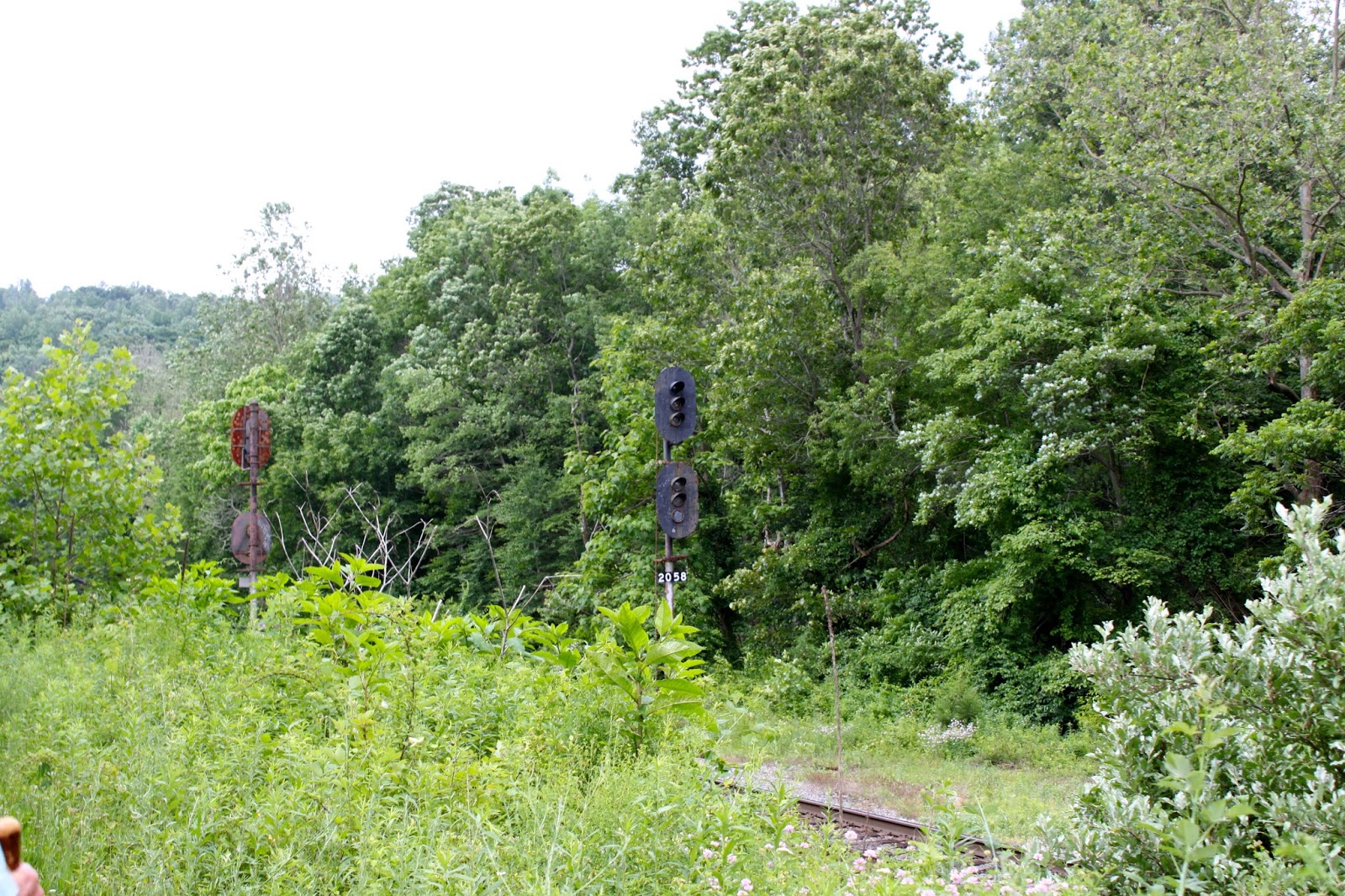
A view of the modern tracks from a path along the historic rail-bed. 


Sabrina makes sure we all make it to the tunnel.


There has been a lot of rain this summer, so the area is full of vegetation, which seems to make the approach to the tunnel even more magical, almost like a true trip through time. 


Rhonda, one of the Clann Mhór community members, graciously agreed to be my scale in this photo. The marks in the rock behind her are testimonies to the labor it took to build this tunnel. Irish laborers used hand-turned drills to create openings in the rock, which were then packed with black powder, in order to blast the rock away.


And here's the tunnel!
 At the time it was built it was the longest tunnel in the United States, at just over a mile in length. The tunnel was designed by Claudius Crozet, who was responsible for three other tunnels and a railroad cut in the area. 


Sabrina was thrilled that she got to come!


More of the drill marks just outside the Tunnel's western portal. 


When you enter the tunnel, you realize that it is lined with thousands of bricks. The bricks are mostly on the western section of the tunnel, in order to maintain the tunnel's structural integrity. They were made specifically for the tunnel from local clay. 


As you walk further you go into the tunnel, you begin to notice the that the light begins to recede and the temperature drops significantly. It is picturesque, but also allows you to begin to imagine what it would have been like to have built this tunnel. 

That is one of the main reasons that we take the field school students on this field trip, so that they can begin to better understand the daily lives of the Irish laborers'.


That and the torches of course. Who wouldn't want to play Indiana Jones for an hour or two?


As you continue into the tunnel, the bricks stop and the raw rock is exposed. It really is eye opening to imagine that all of this was carved out by hand (and took almost a decade to do so!). 


As we turned to leave, we literally went towards the light at the end of the tunnel. It was amazing, coming out of the dark, smokey tunnel into the bright day light (the smoke is from the torches). Yet, we were lucky. Although it was dark, it was no where near as dark as it would have been for the Irish laborers; although it was smokey, it was not unbearable or unhealthy. Trips like these put labor history into a different perspective and allow students to grasp at some of the hardship the Irish immigrants would have endured.


I can't thank our tour guides (Dan, Rhonda, and Michael) enough! Clann Mhór has been so generous throughout this project and I appreciate all their work and enthusiasm. 

And I want to reiterate that we were there with the permission of Nelson County, which is necessary in order to visit the tunnel.